12 Hidden Facts About Mount Everest & Sagarmatha
1. The Naming History of Mount Everest
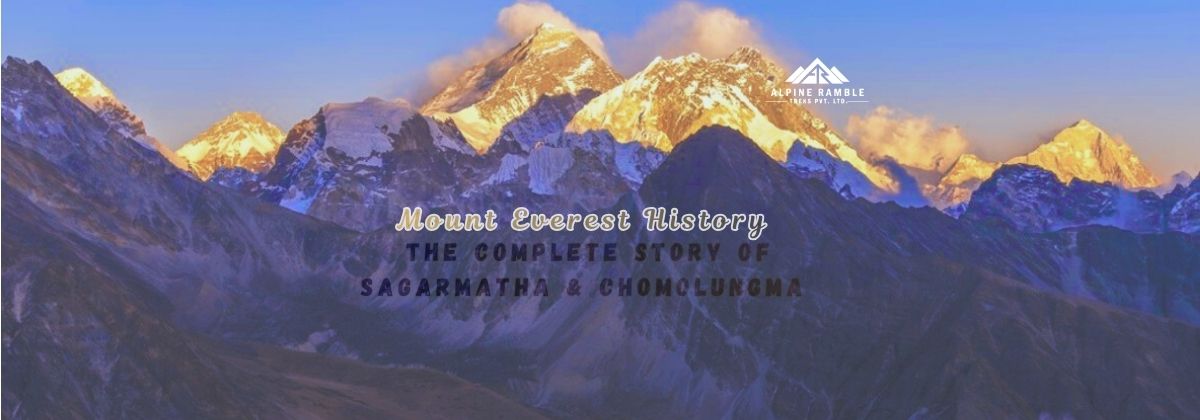
The world’s tallest mountain has a fascinating history. The local Sherpas refer to it as Chomolungma, meaning “Goddess Mother of Earth,” and Sagarmatha, which translates to “Forehead of the Sky” in Nepali.
Interestingly, the name Chomolungma appeared in ancient Tibetan manuscripts long before British cartographers arrived. It wasn’t until 1865 that Andrew Waugh, the British Surveyor General of India, proposed naming Peak XV after his predecessor, Sir George Everest.
Ironically, George Everest himself opposed having the mountain named after him. By the 1920s, British maps officially referred to it as Mount Everest, a name primarily known to Europeans. This decision would change the world of mountaineering forever.
Today, this mountain carries three names, each reflecting a different culture, era, and worldview:
2. The First Everest Ascent Attempt in History
Many believe that George Mallory was the first to attempt to summit Mount Everest, but this is a misconception. While he participated in the expedition, he was merely a team member. The first summit attempt was actually led by Charles Howard-Bury from the North Side of Everest, as Nepal was closed to foreigners in 1921.
Most people don't know that the 1921 expedition had several main objectives:
- To find the route,
- To identify the mountain and locate Everest precisely,
- To see if climbing was possible,
- To study glaciers and understand the weather patterns.
In the following years, George Mallory became a pioneer by attempting to summit Everest, ultimately becoming the face of the first Everest expedition.
He and his partner Andrew Irvine would attempt two more times before vanishing while summiting in 1924.
It wasn’t until 1953 that Tenzing Norgay Sherpa and Sir Edmund Hillary became the first people to successfully reach the "top of the world."
3. Everest Was Not Always Considered the World’s Highest Mountain
Before precise measurements existed, Everest wasn’t the obvious tallest peak. Several mountains briefly held the title of “world’s highest,” not due to their height but because early surveying technology couldn’t accurately determine distance, elevation, atmospheric refraction, and curvature of the Earth.
Here’s how the confusion happened:
- Early 1800s: Dhaulagiri (8,167 m) was widely believed to be the tallest mountain in the world.
- Later in the 19th century, Kangchenjunga took over the title with an estimated height of 8,582 meters.
- The real tallest peak was overlooked: Peak XV (Everest) remained unknown and unmeasured for years due to its extreme distance and geopolitical restrictions.
By 1856, the Great Trigonometrical Survey of India confirmed Peak XV as the tallest at 8,848 meters, ending all other claims. This moment reshaped global geography—Everest’s fame began not with climbing but with mathematics.
4. The First Measurement of Mount Everest
The journey of mapping Everest began when the British colonial administrators aimed to systematically map the entire subcontinent. They started their journey north from the coast of India, measuring rivers, valleys, and mountains.
By 1852, they determined that Peak XV was likely the highest peak on Earth. The distance was calculated to be 29,002 feet from monitoring stations located 240 km (150 miles) away.
Key figure: Radhanath Sikdar
Indian mathematician Radhanath Sikdar made the breakthrough calculation. Based on thousands of data points and trigonometric corrections, he concluded Peak XV was the highest mountain on Earth.
Fun fact: The first recorded height of 29,002 feet was so precise that modern re-measurements differ by less than one meter.
5. Mount Everest Actually Grows Every Year
Believe it or not, Mount Everest grows every year. The mountain, made of rocks and snow, is scientifically proven to grow. The ongoing collision between the Indian Plate and the Eurasian Plate pushes the Himalayas upward a few millimeters annually.
The reasons for this growth include:
- The collision of tectonic plates,

%22%2F%3E%3Cpath%20d%3D%22M0%20620c140-120%20260-180%20360-180s220%2060%20360%20180%20260%20180%20480%20180V800H0z%22%20fill%3D%22%23bfdbfe%22%2F%3E%3Ccircle%20cx%3D%22980%22%20cy%3D%22170%22%20r%3D%2272%22%20fill%3D%22%2393c5fd%22%2F%3E%3C%2Fsvg%3E)